Skip to content


Not long ago, customer service was expected to undergo major changes by the end of the next decade. That future is already here.
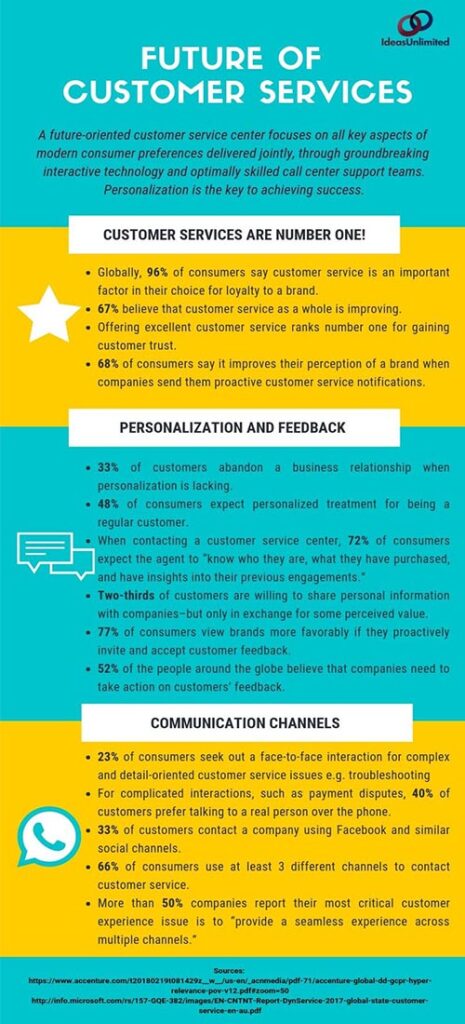
A future-oriented customer service center brings together modern consumer preferences, interactive technology, and skilled call center support teams.
New trends have continued to shape customer service and support. Many predictions have stood the test of time. Digital innovation has transformed how customer service centers operate, including their:
- Communication channels and methods.
- Services and operating hours.
- Time zones and service availability.
- Digital and human interactions.
Today, customer service is becoming part of a business’s core operations. Cloud-based technology has made it possible to combine skilled people, innovative processes, and advanced technology in one integrated system.
Creative disruption also plays an important role in this transformation. Work centers are becoming decentralized, while innovation allows operations to be shared across teams and locations.
In this environment, a reliable service provider can help businesses bring these elements together cost-effectively. It can create a truly omnichannel customer experience by connecting marketing, PR, helpdesks, and social media.
But why do businesses need a specialized customer service center when digitization is taking over? Let’s explore some essential features of a future-oriented customer service center and understand why they are becoming increasingly important.
1. Personalized Omnichannel Support
Customer experience has evolved significantly over the last two decades. New concepts, practices, and expectations have changed how businesses communicate with their customers.
Creating value for customers is now a priority in service delivery. Communication plays a central role in this process.
Modern customer communication takes place across multiple channels. It combines automated interactions with direct conversations between customers and service representatives.
Companies use customer demographics to understand how different groups prefer to communicate. Common channels include:
- Social media.
- Telephone support.
- Email.
- Live chat.
- Video calls.
Customer preferences also vary across generations. Gen Z prioritizes social media customer service, while Millennials often prefer live chats and video calls. Gen X customers are more likely to reach out to a live customer service representative.
Businesses must therefore find effective ways to integrate social media, voice infrastructure, and CRM systems.
Telephone support remains a priority. It offers greater personalization, better Customer Effort Scores, and the flexibility to move between communication channels when resolving complex issues.
2. Voiceprint Identification
The use of smart devices has increased exponentially since the 2000s. This trend was expected to continue through 2025, bringing further opportunities for personalized customer support.
One development in this area is voice recognition. Future-oriented customer service centers are working towards identifying callers through their voiceprints. The information is passed through data channels and organized for customer service representatives.
This process supports:
- Caller identification and verification.
- End-to-end encryption.
- Data exchange between contact centers and CRM applications.
- Faster access to customer information.
With this information readily available, agents can provide more personalized support without spending time collecting basic details during every interaction. Modern consumers do not appreciate long waiting times when retrieving their customer history. They also dislike repeating the same information every time they contact a business. Voiceprint identification helps address these concerns.
3. Shopping the Customer Experience
Another emerging feature is the ability for customers to choose their preferred customer service experience.
This means customers can view available agents and learn more about their:
- Experience and qualifications.
- Language skills.
- Technical skills.
- Location.
- Customer reviews.
Based on their preferences, customers can select an agent and choose their preferred communication channel. They can also decide whether to share their profiles with selected agents for future interactions and support. This approach highlights the value of quality human-to-human interaction. It also shows that consumers are unwilling to compromise on the time and quality of their service experiences.
Customers are comfortable sharing their profiles when they expect credible value in return.
4. Video Sessions
Maintaining uninterrupted communication is essential. Any communication breakdown can lead to customer churn. This has increased the need for customers to move between different communication channels during a single interaction.
Businesses must therefore manage the transition from interactive channels to real-time customer engagement sessions. In a modern customer service center, different communication channels work together.

For example, a customer interaction can follow this path:
- Self-help resources: The customer starts by searching an interactive help library.
- Live chat: The customer moves to a real-time chat when additional assistance is needed.
- Voice support: The conversation progresses to a telephone call.
- Video support: The customer connects through a video call when further interaction is required.
A smart customer service center needs to incorporate video support calls. These can become an important differentiator for premium services.
Video calling can also be enhanced through rich data, content, and digital tools.
Like a telephone conversation with a customer service representative, seeing an agent on a mobile screen can help build a stronger emotional connection. It can also improve understanding and credibility.
This approach meets the need for advanced technology while keeping human contact intact.
5. Data Enrichment and Advanced Analytical Tools
Data enrichment and Big Data are proving to be game changers in customer service.
Tools for collecting data, analyzing information, and turning insights into useful actions will continue to gain importance.
Businesses need detailed analysis to:
- Understand customer journeys.
- Identify service bottlenecks.
- Improve customer touchpoints.
- Reduce customer effort.
- Increase brand loyalty.
Several tools and data sources can support these efforts, including:
- Customer feedback and survey analysis.
- Social media traffic analysis.
- Text analytics.
- Speech analytics.
These tools help identify customer concerns and highlight opportunities for continuous improvement.
Skilled teams in modern contact centers can use advanced analytical tools to manage and interpret customer data.
A well-rounded customer service team can do more than record information. It can collect specific customer feedback and use advanced tools to generate useful insights and achieve better results for the company.
6. Proactive Sales and Marketing
Customer service centers are also becoming part of proactive sales and marketing operations.
They help businesses monitor product or service usage and identify opportunities to offer:
- Resubscriptions.
- Product or service updates.
- Repairs.
These offers encourage customer engagement and loyalty. They also make it easier for customers to make decisions, purchase products, and use services.
Data analytics informs these activities, while customer service representatives handle the direct interactions. A future-oriented customer service center therefore needs a unified system for information exchange and strategy. This allows businesses to provide value to customers while building brand value.
The Human Factor Remains Essential
All six features discussed above represent important requirements for the future of customer service. One thing is clear: the human factor has not been, and cannot be, discounted when discussing the future of customer support. Moving forward requires a technically adaptive customer service center. Agents must be able to resolve complex issues, move between communication channels, and manage customer interactions from beginning to end without interruptions.
Just as customers should not lose communication when switching channels, they should not have to repeat themselves when speaking to a different agent. A 24/7, diverse, and dedicated multilingual customer service center is no longer simply an add-on for businesses operating in a globalized environment. It has become a necessity for global business operations.
You don’t have to wait any longer to move toward more sophisticated, digitally advanced customer support. The right solution combines technology with the human element that remains essential to customer service.
Contact a specialized IdeasUnlimited today and get a customized solution for your business.