Skip to content
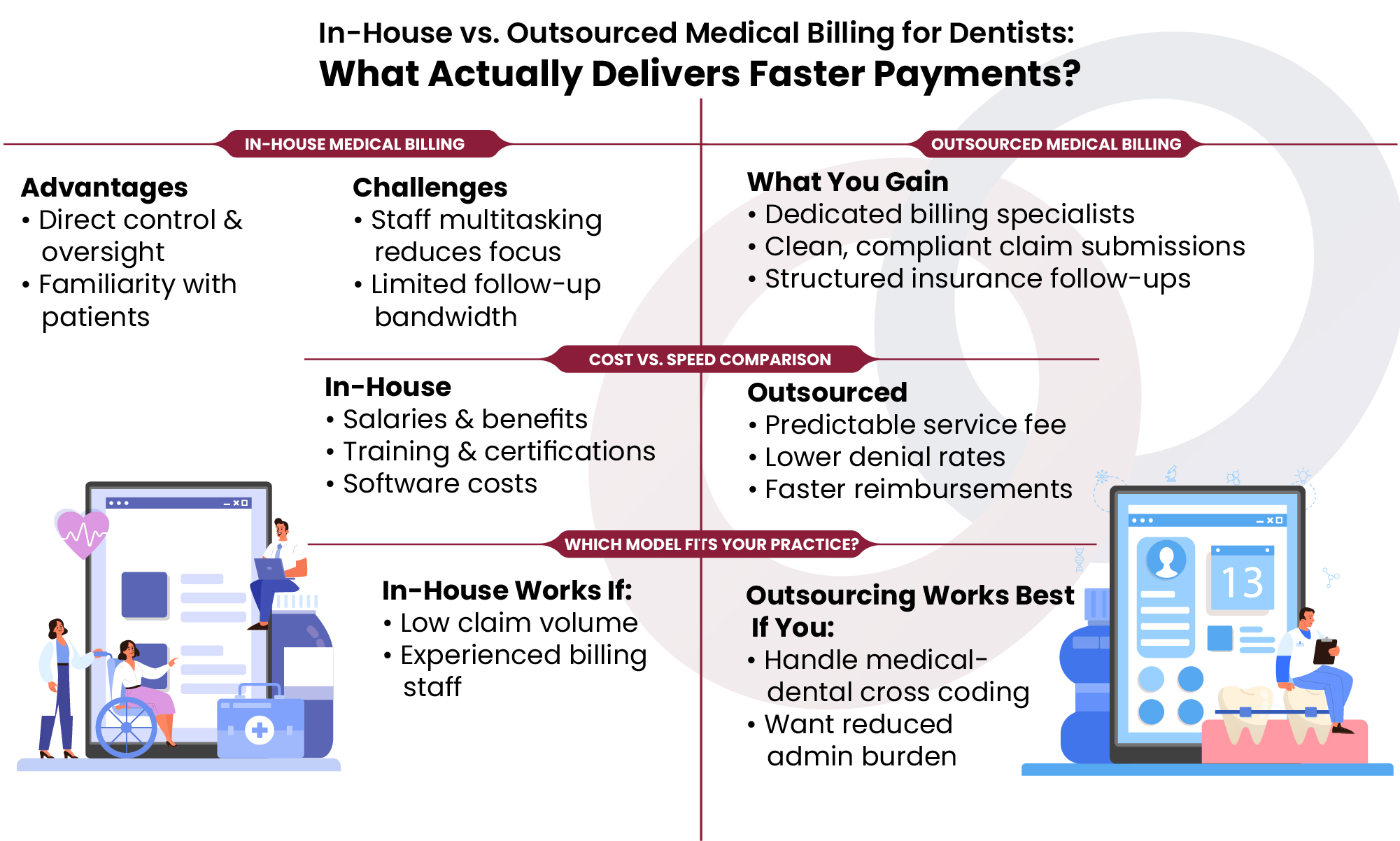
Cash flow is the lifeline of every dental practice. While patient care is the priority, timely reimbursements determine how smoothly operations run behind the scenes. For many dentists, delayed or denied claims are not the result of insurance complexity alone but of how medical billing is handled.
The decision often comes down to two options: managing billing in-house or partnering with a third-party medical billing provider. On paper, both approaches aim for the same outcome; accurate claims and faster payments. In reality, their impact on turnaround time, consistency, and revenue can be very different.
Understanding what actually speeds up reimbursements helps dental practices make informed decisions that protect both revenue and staff productivity.
Understanding In-House Medical Billing for Dental Practices
In-house medical billing places responsibility for coding, claim submission, follow-ups, and payment posting on your internal team. While this approach gives practices a sense of control, it comes with both advantages and limitations that directly affect reimbursement speed.
Advantages of In-House Medical Billing
- Direct oversight provides visibility.
Dentists and office managers can monitor claims closely, identify issues early, and make immediate adjustments. Because communication stays within the practice, questions are resolved faster and workflows can feel more transparent.
- Familiarity with patients supports accuracy.
In-house staff understand patient histories, treatment plans, and insurance details. This familiarity can help reduce basic data entry errors and ensure clinical documentation aligns with the services billed.
- Immediate access simplifies communication.
When questions arise, staff can collaborate quickly without waiting on an external partner. This accessibility can be helpful for urgent clarifications or last-minute corrections before claim submission.
While managing billing in-house gives dental practices more control and immediate access to claims, these benefits can be offset by the demands placed on staff. Without dedicated expertise or sufficient time, even small errors or delayed follow-ups can slow reimbursements and create bottlenecks. Here’s how:
Training requirements create ongoing pressure.
Dental medical billing requires up-to-date knowledge of CDT, CPT, and ICD-10 codes, along with frequent payer policy changes. Maintaining this expertise demands time, continuous training, and financial investment.
- Staff overload reduces efficiency.
Front-desk teams often manage scheduling, patient communication, eligibility checks, and billing simultaneously. When attention is divided, errors increase and claims take longer to process.
- Limited follow-up capacity slows payments.
Insurance companies often require multiple follow-ups before releasing payment. Many in-house teams lack the bandwidth to pursue every unpaid or underpaid claim consistently, allowing claims to age unnecessarily.
- Minor inefficiencies
Delays in training, documentation, or follow-ups can extend reimbursement timelines by weeks, tying up revenue and placing additional strain on daily operations.
Understanding Outsourced Medical Billing and Coding

Outsourced medical billing, also called third-party billing, involves transferring responsibility for claims management to an external team of specialists who handle billing for multiple healthcare providers, including dental practices. Rather than having your front-office staff divide attention between patient care, scheduling, and complex billing requirements, these teams focus exclusively on managing the full revenue cycle. This includes claim submission, follow-ups, denial resolution, and payment posting, all of which are handled according to established processes designed to maintain accuracy and efficiency.
Because these teams work across multiple practices, they develop standardized procedures for reviewing documentation, coding treatments, and ensuring compliance with payer requirements. They also implement structured workflows that track every claim from submission to payment, monitor aging claims, and systematically address any delays or denials. By centralizing and standardizing these processes, outsourced billing creates a consistent approach to handling claims, reducing the risk of mistakes and missed payments.
Additionally, third-party billing providers integrate reporting and performance tracking into their workflows, giving practices visibility into claim status, reimbursement trends, and areas that may require attention all without adding administrative burden to in-house staff. This model also allows for scalable support, so practices can handle fluctuations in claim volume or seasonal demand without hiring additional personnel. In short, outsourced billing shifts the administrative complexity off the dental office while maintaining structured, monitored processes that keep payments moving efficiently
What Actually Impacts Payment Speed?
Faster payments depend less on where billing is handled and more on how efficiently core processes are executed.
- Accuracy at submission: Clean claims reduce rejections. Outsourced billing teams typically have lower error rates due to specialization and quality checks.
- Timely follow-ups: Insurance companies rarely pay without reminders. Third-party medical billing teams follow structured follow-up schedules to prevent claims from stalling.
- Denial management: Understanding why claims are denied and correcting them quickly is critical. Experienced billing specialists resolve denials faster than general administrative staff.
- Compliance awareness: Incorrect coding or missing documentation can trigger audits or delays. Outsourced billing providers monitor compliance closely to avoid setbacks.
While in-house teams may perform well initially, consistency often declines during busy periods or staff turnover.
Cost vs. Speed: A Practical Comparison
Many practices assume in-house billing is more cost-effective. However, costs extend beyond salaries.
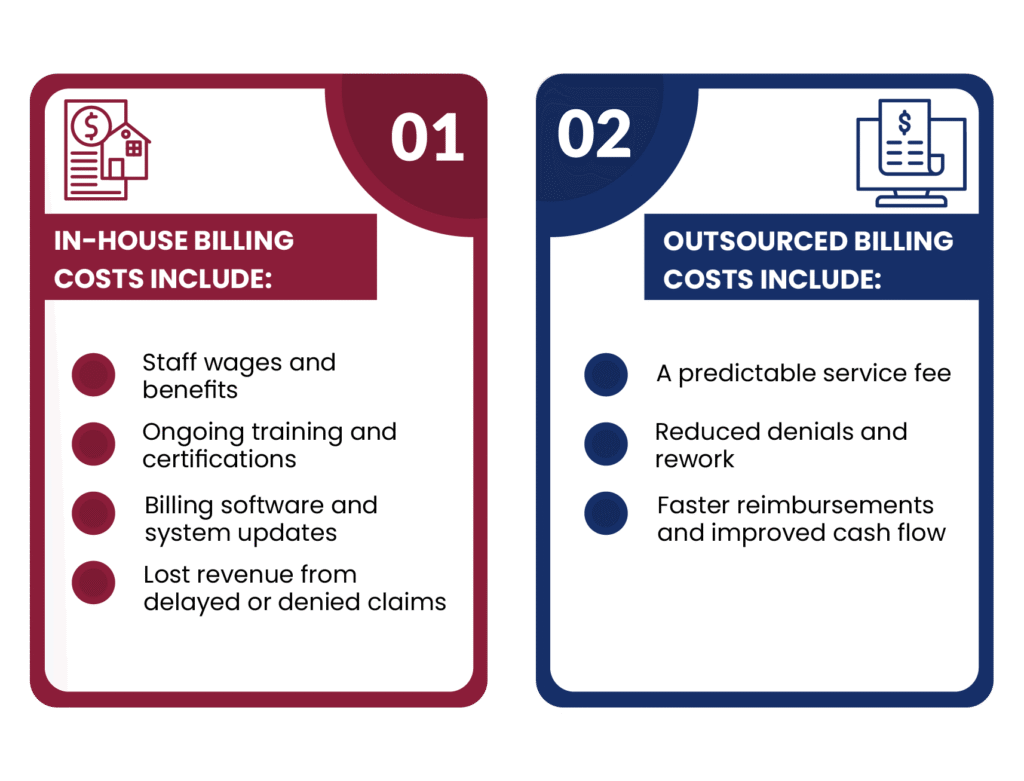
When reimbursement speed improves, the impact on cash flow often outweighs the perceived savings of keeping billing internal.
Which Model Works Best for Dental Practices?
Small practices with low claim volumes and experienced billing staff may manage well in-house. However, as procedures become more medically complex, billing demands increase.
Practices that benefit most from outsourced medical billing include those that:
- Handle medical-dental cross coding
- Experience frequent denials or delays
- Want to reduce administrative burden
- Need consistent follow-ups without adding staff
Outsourcing does not remove control. Instead, it replaces manual effort with structured expertise and accountability.
A Smarter Path to Faster Payments

For dentists focused on patient care and growth, medical billing should not be a daily struggle. Faster payments result from accuracy, persistence, and expertise; areas where third-party medical billing teams excel.
IdeasUnlimited provides medical billing and coding services tailored for dental practices. Our third-party medical billing teams manage submissions, follow-ups, and denials helping practices reduce delays and stabilize cash flow. You gain transparency, consistency, and results without the overhead of managing billing in-house.
Stop waiting on insurance companies. Streamline your billing process and get paid faster with support that works as an extension of your practice. Schedule a consultation with IdeasUnlimited and take control of your revenue cycle today.