Skip to content

Cash flow is the lifeline of every dental practice. While patient care remains the priority, timely reimbursements help keep daily operations running smoothly.
For many dentists, delayed or denied claims are not caused by insurance complexity alone. The way medical billing is handled also plays an important role.
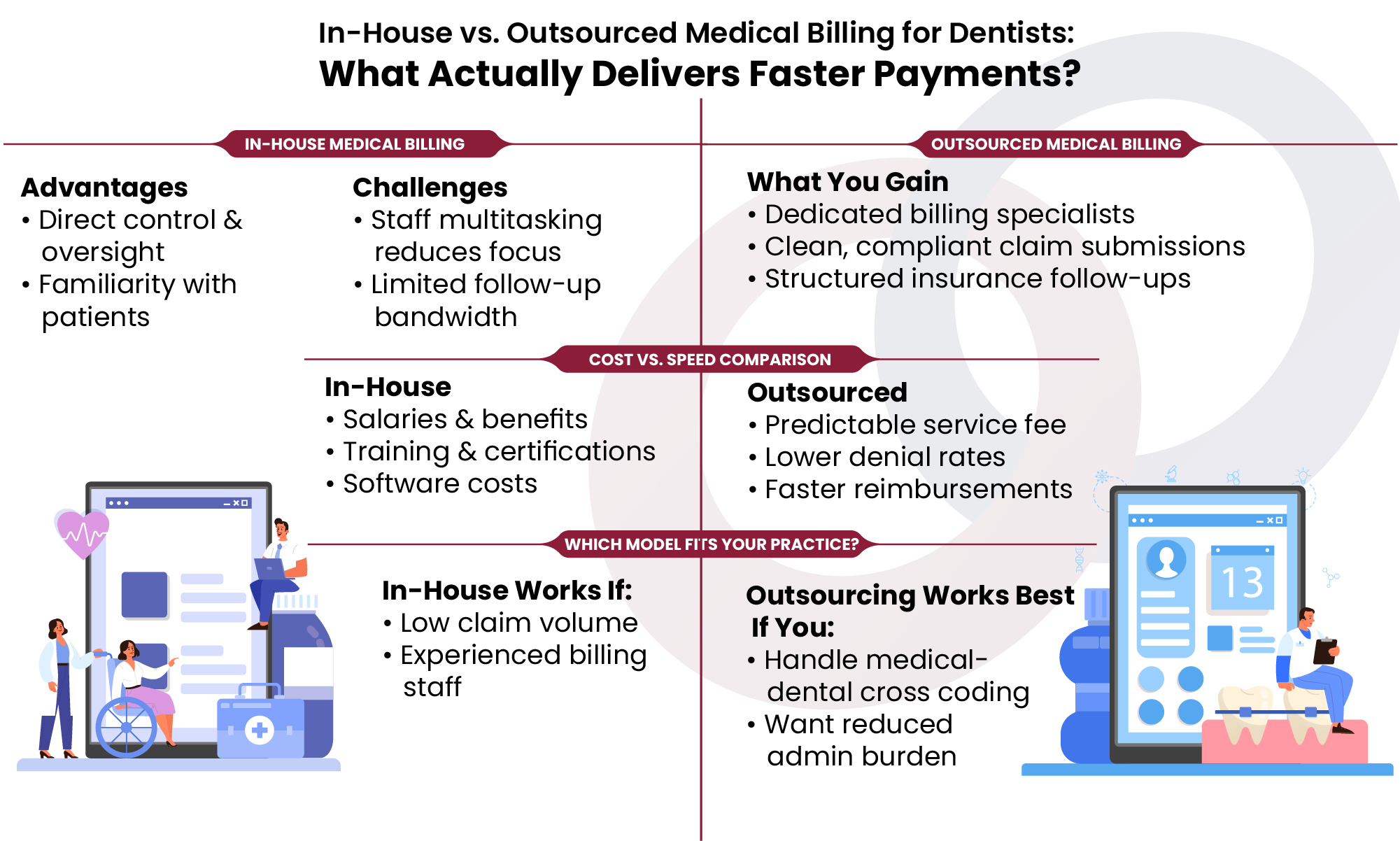
Dental practices generally have two options: manage billing in-house or partner with a third-party medical billing provider.
Both approaches aim for the same results: accurate claims and faster payments. However, they can differ significantly in turnaround time, consistency, and revenue.
Understanding what speeds up reimbursements helps dental practices make informed decisions. It also helps protect revenue and staff productivity.
Understanding In-House Medical Billing for Dental Practices
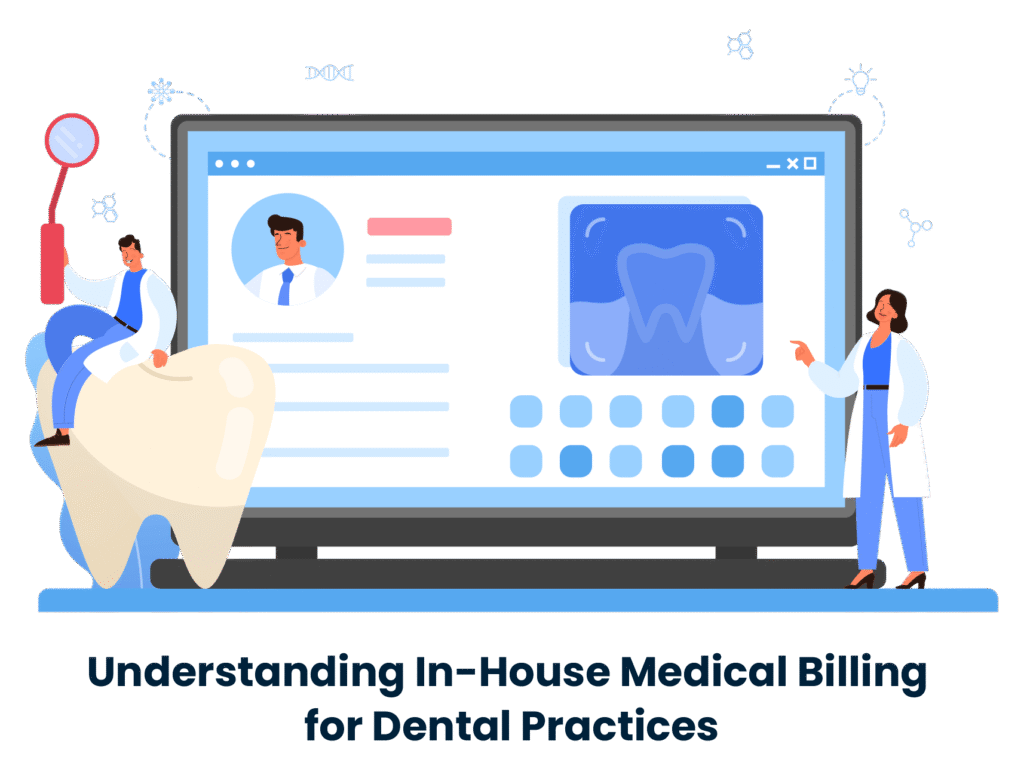
In-house medical billing places responsibility for coding, claim submission, follow-ups, and payment posting on your internal team.
This approach gives dental practices direct oversight of their billing activities. However, it also comes with advantages and limitations that can affect reimbursement speed.
Advantages of In-House Medical Billing
- Direct oversight provides visibility.
Dentists and office managers can closely monitor claims, identify issues early, and make immediate adjustments.
Since communication stays within the practice, questions can be resolved faster. Workflows may also feel more transparent. - Familiarity with patients supports accuracy.
In-house staff understand patient histories, treatment plans, and insurance details.
This familiarity can reduce basic data-entry errors. It also helps ensure clinical documentation aligns with billed services. - Immediate access simplifies communication.
When questions arise, staff can collaborate quickly without waiting for an external partner.
This accessibility is useful for urgent clarifications and last-minute corrections before claims are submitted.
While in-house billing provides more control and immediate access to claims, these benefits can be offset by the demands placed on staff.
Without dedicated expertise or sufficient time, even small errors and delayed follow-ups can slow reimbursements and create bottlenecks.
Challenges of In-House Medical Billing
- Training requirements create ongoing pressure.
Dental medical billing requires up-to-date knowledge of CDT, CPT, and ICD-10 codes. Payer policies also change frequently.
Maintaining this expertise requires time, continuous training, and financial investment. - Staff overload reduces efficiency.
Front-desk teams often handle several responsibilities simultaneously, including:
- Scheduling.
- Patient communication.
- Eligibility checks.
- Billing.
- When attention is divided, errors can increase, and claims may take longer to process.
- Limited follow-up capacity slows payments.
Insurance companies often require multiple follow-ups before releasing payment.
Many in-house teams lack the time to consistently pursue every unpaid or underpaid claim. As a result, claims can age unnecessarily. - Minor inefficiencies
Delays in training, documentation, or follow-ups can extend reimbursement timelines by weeks.
This ties up revenue and adds pressure to daily operations.
Understanding Outsourced Medical Billing and Coding

Outsourced medical billing, also called third-party billing, involves transferring claims management responsibilities to an external team of specialists.
These specialists handle billing for multiple healthcare providers, including dental practices.
Instead of dividing their attention between patient care, scheduling, and complex billing requirements, front-office staff can focus on their primary responsibilities.
Outsourced teams manage the full revenue cycle, including:
- Claim submission.
- Follow-ups.
- Denial resolution.
- Payment posting.
These activities follow established processes designed to maintain accuracy and efficiency.
Because outsourced teams work across multiple practices, they develop standardized procedures for:
- Reviewing documentation.
- Coding treatments.
- Checking payer requirements.
- Tracking claims from submission to payment.
- Monitoring aging claims.
- Addressing delays and denials.
By centralizing and standardizing these processes, outsourced billing creates a consistent approach to claims management. This reduces the risk of mistakes and missed payments.
Third-party billing providers also incorporate reporting and performance tracking into their workflows.
This gives dental practices visibility into:
- Claim status.
- Reimbursement trends.
- Areas requiring attention.
Practices gain this visibility without adding administrative work for their in-house staff.
Outsourcing also allows for scalable support. Practices can manage changes in claim volume or seasonal demand without hiring additional personnel.
In short, outsourced billing shifts administrative complexity away from the dental office while maintaining structured and monitored processes to keep payments moving efficiently.
What Actually Impacts Payment Speed?
Faster payments depend less on where billing is handled and more on how efficiently core processes are completed.
Several factors influence reimbursement speed:
- Accuracy at submission: Clean claims reduce rejections. Outsourced billing teams typically have lower error rates due to specialization and quality checks.
- Timely follow-ups: Insurance companies rarely pay without reminders. Third-party medical billing teams follow structured schedules to prevent claims from stalling.
- Denial management: Understanding why claims are denied and correcting them quickly is critical. Experienced billing specialists resolve denials faster than general administrative staff.
- Compliance awareness: Incorrect coding or missing documentation can trigger audits or delays. Outsourced billing providers monitor compliance closely to avoid setbacks.
In-house teams may perform well initially. However, consistency can decline during busy periods or when staff members leave.
Cost vs. Speed: A Practical Comparison
Many dental practices assume in-house billing is more cost-effective. However, the actual costs extend beyond employee salaries.
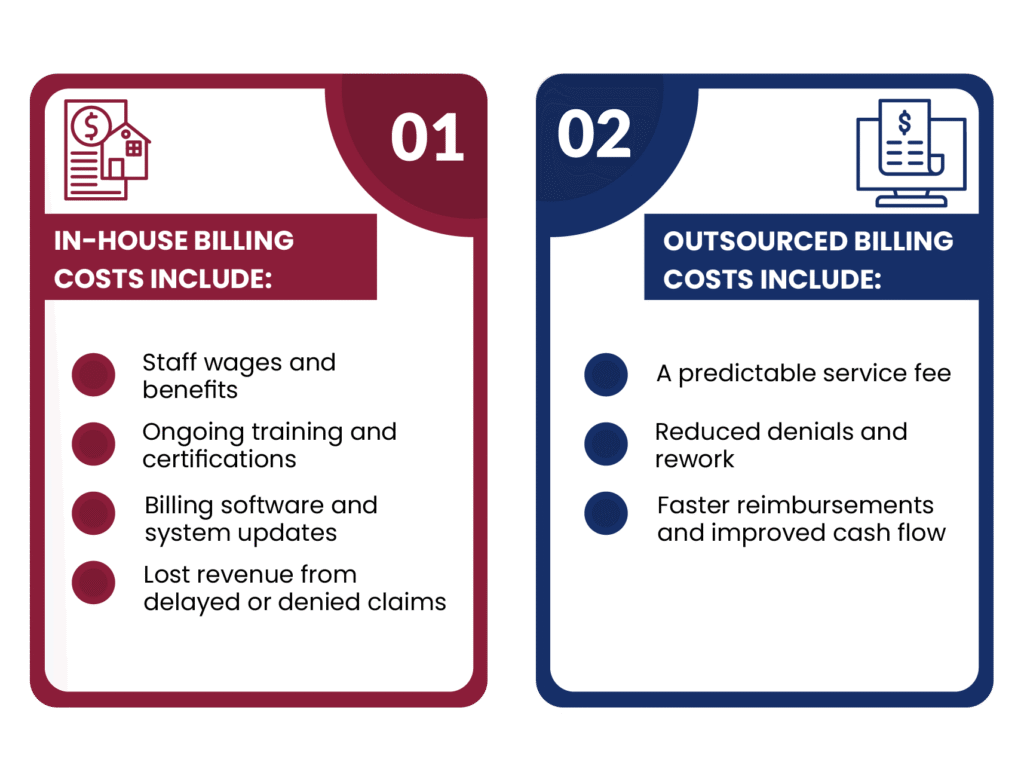
When reimbursement speed improves, the positive impact on cash flow can outweigh the perceived savings of keeping billing operations internal.
Which Model Works Best for Dental Practices?
Small practices with low claim volumes and experienced billing staff may manage billing successfully in-house.
However, billing demands increase as procedures become more medically complex.
Practices that benefit most from outsourced medical billing include those that:
- Handle medical-dental cross-coding.
- Experience frequent denials or payment delays.
- Want to reduce their administrative burden.
- Need consistent follow-ups without adding staff.
Outsourcing does not mean giving up control. Instead, it replaces manual effort with structured expertise and accountability.
A Smarter Path to Faster Payments

For dentists focused on patient care and business growth, medical billing shouldn’t be a daily struggle.
Faster payments depend on accuracy, persistence, and expertise. These are areas where third-party medical billing teams excel.
IdeasUnlimited provides medical billing and coding services tailored to dental practices.
Our third-party medical billing teams manage:
- Claim submissions.
- Follow-ups.
- Denials.
This support helps practices reduce delays and stabilize cash flow. You gain transparency, consistency, and results without the overhead of managing billing in-house.
Stop waiting on insurance companies. Improve your billing process and get paid faster with support that works as an extension of your practice.
Schedule a consultation with IdeasUnlimited and take control of your revenue cycle today.